Meet the founders rewiring the energy transition and putting wind back in shipping’s sails - Climate Tech Time
Last week, the Conduit was buzzing. A packed room, a hum of anticipation, and a palpable sense of togetherness as Climate Connection kicked off the 33rd evening of Climate Tech Time – the UK’s largest monthly gathering for climate tech.
From the very first moment, the evening invited us into stories that made clear the complexity of the green energy transition and something equally important: all of these scripts of “but that’s how it’s always been done” can be flipped. Often simply by changing the question.
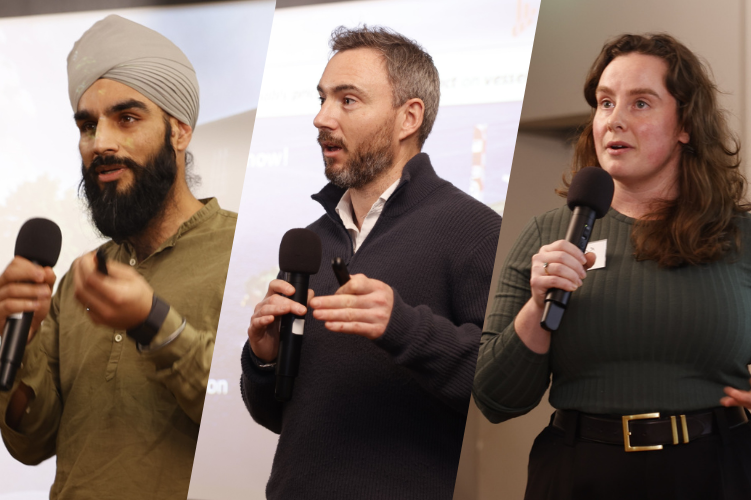
Together, three founders explored two approaches to the scaling of warmer, safer, more comfortable, and energy-efficient homes – and one innovative approach to putting wind back into the sails of the global shipping industry.
Amandeep Karla, architect and founder of GreenFlip, opened the evening and wasted no time pulling us in. He began by showing us the housing block he grew up in southwest London, describing the cold as “the kind that gets into your body and bones in October and stays with you right until April”. After making multiple complaints to the council, they eventually fitted insulation that turned into damp and mould after a few months.
That was over fifteen years ago, and Amandeep shared the alarming statistic that even now,98% of insulation installed recently under the EC04 scheme has failed. Even startups, Amandeep noted, have a higher success rate than that.
For Amandeep, the challenge is that we’ve been asking “How do we keep heat in?” for decades. But what if we flipped the question and asked instead: “How do we create homes that are comfortable and cheap to run?”
Through a combination of heat pumps, solar, batteries, and smart tariffs, Amandeep argues that 29 million UK homes could themselves become distributed power stations, generating and storing their own energy at the point of use. This would halve bills, eliminate fuel poverty for the quarter of UK households suffering from it, and save the NHSthe £1.3 billion it spends annually treating conditions caused by damp and mould.
GreenFlip has built the financial modelling platform to make that investable at scale – helping housing teams, social landlords, and investors understand where to put their money and what the returns and impact will be.
Connect with Amandeep on LinkedIn to see more of his work or check out GreenFlip for more info on making smarter retrofit investments.
“This isn’t about arbitrary EVC targets or a bit of insulation here and there. It’s about homes that can generate more energy, so we don’t have to build one gigantic power station. We already have 29 million of them here.”
– Amandeep, Founder of GreenFlip
George Thompson, founder of GT Wings, followed with a solution that solves one of climate’s hardest problems: decarbonising shipping. Shipping, George reminded us, accounts for up to 3% of global CO2 emissions – around a billion tonnes a year. It also moves 80 to 90% of everything traded in the world.
Decarbonising it is anything but straightforward. With ships lasting 25 years, anyone ordering a vessel today needs to think about how it will operate in 2050. Regulation is tightening, carbon costs are rising, and the available technology is, to put it lightly, limited.
Enter GT Wings. George and his team have developed a small unit that can manipulate airflow in a way borrowed from aeronautics – and briefly from Formula One before it was banned – to bring wind back into shipping. The result is a significant thrust from a footprint small enough to fit in a 2x2 metre square on deck, vital when most ships have almost no deck space.
GT Wings’ very first commercial jet sail is crossing the Atlantic as we speak, expected to save the ship between 8 to 10% in fuel over a year. Their ambition: install 600 wings in five years, abating an estimated 21 million tonnes of CO2.
Follow George on LinkedIn to see more of his work or head on over to GT Wings to learn more.
“Our ambition is to install 600 of these wings in the next five years. It’s a big ask, but it’s definitely achievable. If we can do that, we can abate over 21 million tonnes of CO2.”
– George, Founder of GT Wings
Becky Lane, Co-Founder and CEO at Furbnow, closed the evening – and arrived ready to slightly disagree with something.
Where Amandeep had focused on the investment infrastructure needed to fund retrofit at scale, Becky zeroed in on the human problem sitting upstream of all of it: consumer confidence or rather, the systemic destruction of it.
Before founding Furbnow three and a half years ago, Becky led a £30 million retrofit programme in the West Midlands. She saw, up close, exactly how this went. The interest was there: 72% of homeowners wanted to make changes. Then came the research phase, and that number dropped sharply to 28%. Then came the decision stage, and it dropped further still. Every step of the current process, she argued, is designed unintentionally to slow down momentum.
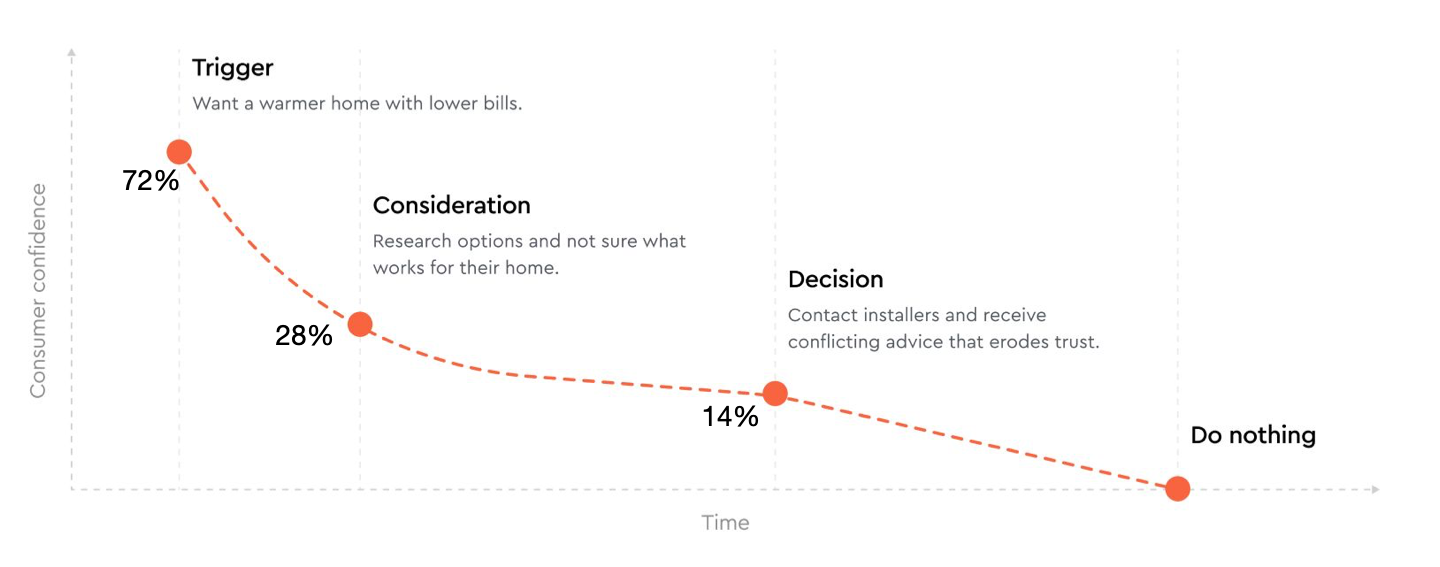
Becky showed photos of the UK housing stock as a patchwork of different eras, materials, and conditions. The people living inside them have different incomes, ambitions, priorities, and family situations. There is no one-size-fits-all answer. And so most people do nothing. The utopia of a home that is comfortable and affordable to run stays out of reach – not because the technology doesn’t exist, but because the journey to get there feels impossibly complicated.
Furbnow’s answer is to make that journey navigable – to scan the home, build a baseline model, then design the right solution for that specific building, source the right products, and standardise delivery through supply chain partners across England and Wales. Then do it again and again, because the only way to fix the 98% ECO4 failure rate Amandeep described is to treat retrofit less like a compliance exercise and more like a renovation service that people actually want to use.
“My mission is to kill the word retrofit, because most consumers don’t know what it is and really be the renovation company that fixes this. Our mission is 100,000 homes a year.”
– Becky, Founder of Furbnow
Follow Becky on LinkedIn to see more of her work.
Every time we hear from the founders at Climate Tech Time, it fills us with hope for the climate future.
GreenFlip, GT Wings, and Furbnow aren’t abstract solutions but real answers to real frustrations, made possible because founders kept believing and investors kept backing them. Climate utopias will never arrive fully formed. They are built, piece by piece, in rooms exactly like this one.
Want to come along to the next one? Climate Tech Time will be back on 25th March; click here to secure your ticket.
For more stories from our community of innovators, investors, and climate changemakers, follow us on LinkedIn.