Meet the founders designing for water resilience, greener heating, and the circular economy in food delivery - Climate Tech Time
It’s been two weeks since our 36th edition of Climate Tech Time, where the tube strikes were called off and our space in the Conduit was filled once again with the incredible climate community.
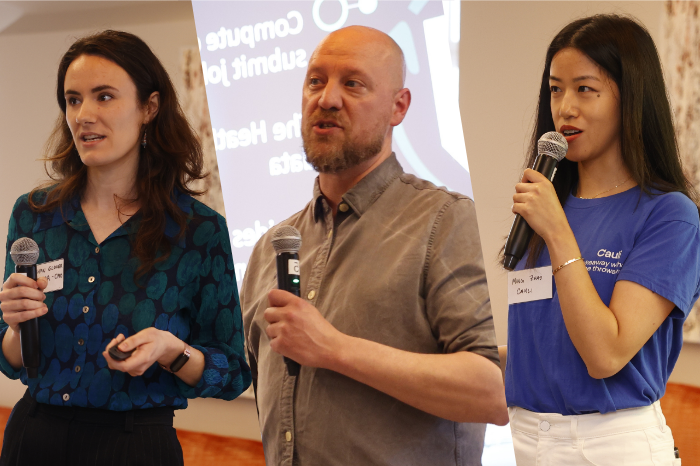
Siobhan Glover, CMO of Ahbstra, Travis Theune, CEO and Co-Founder of Thermify, and MingQiao Zhao, Co-Founder and CEO of Immaterial, shared how engineering and commercialisation must work in parallel to bring their technology (for Ahbstra and Immaterial, Nobel Prize-winning breakthroughs in Metal Organic Frameworks) into real-world adoption.
The hardest problems are rarely solved in silos. This evening was once again proof of what happens when you create conditions for the right people to find each other at the right time.
Read on for the full roundup.
Moving the needle on water resilience
Siobhan Glover, CMO of Ahbstra, kicked off by challenging the idiom: “If you build it, they will come.” She shared how marketing and engineering must work in parallel, and the founding story of the startup moving the needle on water resilience.
In 2019, Ahbstra’s founder Hashem Arouzi was living in Ibiza when his 200-metre deep well completely dried up, leaving him solely reliant on trucked water. 70% of Southern Europeans experience water scarcity every year and 13% suffer it year-round. The need for water resilience technology is incredibly acute.
While Hashem was looking for a solution, he came across the concept of Metal Organic Frameworks (MOFs) – a technology that’s having its moment right now, with one of its pioneers winning a Nobel Prize in November 2025. These ultra-porous crystalline structures made from metal ions linked by organic molecules can absorb materials from the air, including water at very low humidities.
In the regions that need this water at the moment, this could be a breakthrough.
As Ahbstra uses its patent technology and become the first to commercialise large-scale water harvesters, there are two challenges. The first is the engineering required to develop the product, and the second is to challenge the status quo, make the potential evident, build trust and credibility, and make adoption easy.
Connect with Siobhan on LinkedIn to follow her journey, or visit Ahbstra to learn more about how they are engineering water from air.
“If you build it, they will come, but only if you challenge the status quo, make the breakthrough understandable, build trust and credibility, and make adoption feel easy.”
– Siobhan Glover, CMO of Ahbstra
Using energy twice for a greener system with a micro data-centre
Travis Theune, CEO and Co-Founder of Thermify, struck a chord first with the physicists. How do you help the UK transition away from fossil fuels for heating homes and reuse some of the electricity that’s being used to run data centres? Effectively, how do you use energy twice?
For Thermify, there’s a technology that can solve both.
Thermify have designed a micro-data centre that is small enough to fit in a garden shed. This heat hub takes the heat generated by running cloud computing jobs and uses it to heat the home instead, reducing heating costs to next to nothing for the homeowner while delivering cloud services at cost.
With 24 million homes needing to replace their gas boilers and cloud computing shooting through the roof by 2032, the statistics themselves are bewildering. Thankfully, so is the opportunity to use some of this electricity to benefit communities, bring down energy bills, and tackle heat poverty.
Follow Thermify’s fundraising journey to build 2,000 units before scaling this out to the 24 million homes that need the change, and Travis Theune on LinkedIn for more updates.
“As data centres gobble up energy that could be used for communities and we need to transition from fossil fuels to electric heat, we can solve two problems with one stone.”
– Travis Theune, CEO and Co-Founder of Thermify
Helping food delivery ditch the disposables
Mingqiao Zhao, Co-Founder of Cauli, closed the evening by sharing the remarkable journey of CauliBox, a climate tech startup that was born in London in 2022 and in just four years, has become the UK’s largest reuse system for food service.
Mingqiao is no stranger to entrepreneurship. In fact, she was 14 when she set up her first company collecting and selling recyclables to waste managers in China. When she moved to London, she watched her friend dumpster-dive as part of a programme to highlight the scale of food waste – and together they decided to tackle the enormous challenge of single-use takeaway packaging.
We throw away 500 billion single-use boxes and cups every year globally after one use, usually in less than half an hour
Just 14% of those get recycled or commercially composted because as soon as a package is ‘contaminated’, it’s no longer recyclable unless you wash and dry it.
What’s more, if reusable packaging is not being used multiple times, it can have an even larger impact on the environment than single-use due to the energy involved in its manufacture
For Mingqiao, there was a solution.
Mingqiao started Cauli to use technology to help restaurants, ghost kitchens, cafes, and more provide their customers with reusable packaging they can borrow and return. They started in Mingqiao’s living room, painting a laundry basket that would become their first drop-off point, and in a Pimlico street food market.
In the past four years, they’ve developed a bar code that customers can use to link a payment method and put down a mini ‘deposit’ that will be returned when they bring the package back to a return point.
That return point is no longer a laundry basket; Josephine is no longer dumpster diving, but MingQiao is absolutely still an entrepreneur. Plus, Cauli has stuck to its guns, ensuring that circularity and traceability are at the core of its value. Over the next five to eight years, they’ll be building toward a vision where reusability completely replaces single-use.
“Our ability to track traceability means we can help our partners go from losing 3,000 sets of reusables to reaching a 99% return rate. For too long, sustainability has been seen as a cost, yet through Cauli, they are reducing packaging costs by up to 40%.”
– Mingqiao, Co-Founder of Cauli
Follow Mingqiao on LinkedIn or visit Cauli to discover how they are making reusables the new norm in food service.
In a moment when so much feels uncertain, fast-moving, and out of control, there’s something deeply reassuring about hearing what startups are doing to steer the collective ship on a positive trajectory toward net zero, cleaner drinking water, greener heating systems, and reusable packaging.
And it’s this that is the work of everyone, from Nobel Prize scientists to storytellers, engineers, and entrepreneurs.
Our next Climate Tech Time is on Wednesday, 20 May. Sign up for our newsletter for updates on all London climate events happening in the month, and follow us here for more updates.