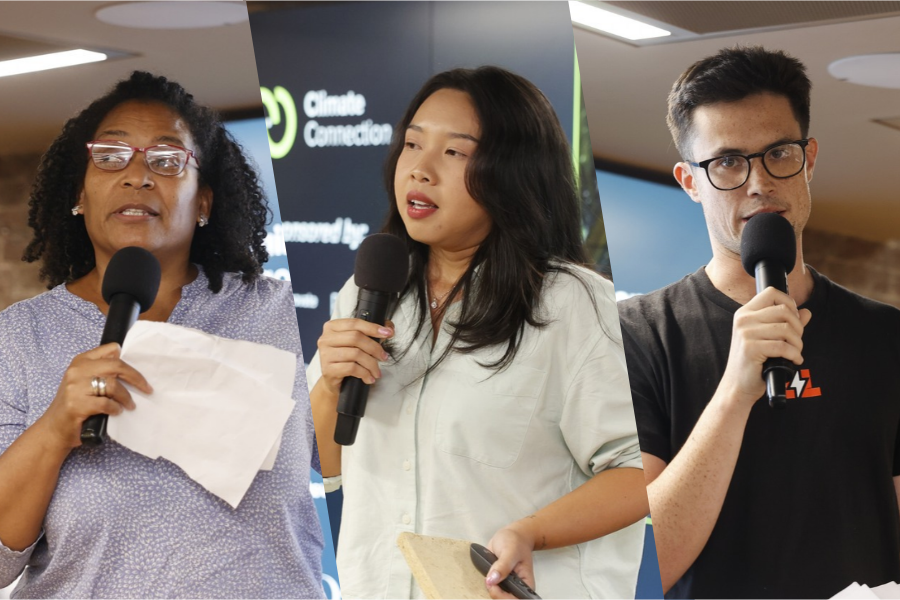
In September, we hosted our 40th Climate Tech Time in a room full of founders, entrepreneurs, investors, and more. After a summer of heatwaves and at the start of a busy autumn season, the Climate Connection community turned out to hear how three founders have brought their technologies to market.
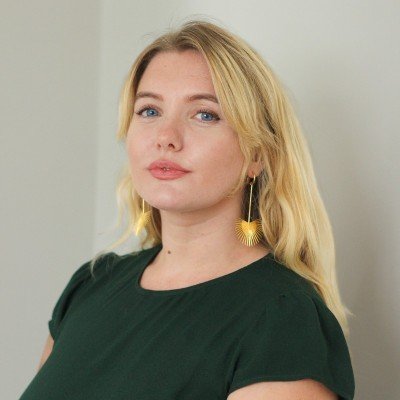
Eva Thorne, Co-Founder and Chief Strategy Officer at Lagos Carbon, questioned how Western investors price risk in Africa and explained how a government-backed platform is closing the trust gap in voluntary carbon markets.
My Linh Nguyen, Co-Founder and COO of Agreka Build, traced a path from a childhood beside Vietnam’s brick kilns to a circular insulation board made entirely from straw.
Then Dylan Johnson, Founder of Tariff Tribe, wrapped up the evening with stories from the brewery, the chicken shop, and the pub, illustrating how small businesses can be incentivised to decarbonise.
Read on for the full roundup.
Closing the trust deficit in Africa’s voluntary carbon markets
Eva Thorne, Co-Founder and Chief Strategy Officer at Lagos Carbon, opened with an image of two rooms looking at one another. On the left, a London boardroom of investors where you can see who’s at the table and who isn’t. And on the right, a nurse in a Lagos hospital that’s running on solar power. The investors might see the hospital’s solar panel as a risk rather than an asset, while the nurse mainly cares that the lights stay on in the maternity ward.
Both, Eva argued, are understandable but slightly wrong. She argues that risk in Africa is typically overpriced and overstated, and the data supports her; drawing on Moody’s figures, Western Europe’s infrastructure project default rate is more than twice Africa’s. The same misconceptions follow Africa’s voluntary carbon markets.
Eva, and Lagos Carbon, believe that these are addressable through:
Acquiring sovereign backing
Replacing analogue monitoring with better technology
Standardising methodologies
Bringing in the communities that have been marginalised
In practice, that means a government-mandated exclusivity agreement, as far as the team knows, the only one of its kind anyway, plus binding agreements that let them onboard solar-powered hospitals and schools. Their completed pilot is already issuing I-RECs, with demand arriving from across Africa, the Caribbean, and the Middle East. Underpinning it all are internationally recognised methodologies, AI anomaly detection, and tamper-proof blockchain records.
Ultimately, it doesn’t make sense to spend resources primarily in the global north when most of the world’s fastest-growing economies are in Africa, where a young population of over half a billion people drives creativity, innovation, and an entrepreneurial ecosystem.
Connect with Eva on LinkedIn to follow her work, or visit Lagos Carbon to learn more about how they’re rebuilding trust in African carbon markets.
“Facts are stubborn things, and misconceptions are more stubborn still.”
– Eva Thorne, Co-Founder and Chief Strategy Officer at Lagos Carbon
Turning straw that would otherwise be burned into walls
My Linh Nguyen, Co-Founder and COO of Agreka Build, was born in Vietnam after the American war and spent the first ten years of her life in extreme poverty. Mud was her play-doh, flowers and leaves were her pretend tea party, and a rainy afternoon was a surprise trip to the water park. That childhood left her with a deeply rooted connection to nature.
Her parents had started off in the military. After they left the army, they started several business ventures, from a chicken farm to training as mechanics, then running a very successful brick manufacturing operation. These bricks rebuilt many of Vietnam’s collapsed hospitals and road infrastructure, and they paid for My Linh’s international education.
But it was also what released endlessly thick black smoke into the sky. My Linh quickly realised this industry wasn't for her.
She spent the first decade of her career in agriculture, working in social innovation with farming communities across Southeast Asia, from the United Nations to running her own incubator. And she kept meeting the same problem: agricultural residues like straw, openly burned around the world, released the same thick black smoke.
With agriculture and construction accounting for 65% of global CO2 emissions, Agreka Build converts agricultural biomass and natural fibres into green construction materials, a circular insulation fibreboard made from 100% straw fibre, with no synthetic chemicals or binders. It’s naturally fire-resistant without added retardants, regulates moisture and mould indoors, and has a positive carbon footprint in the built environment. It works as thermal or acoustic insulation, or as lightweight structural and interior panelling.
Straw is the oldest insulation in the world, used across civilisations since ancient times. My Linh explained that the innovation is proprietary technology that turns a regenerative material into modern products that meet modern performance and carbon standards.
Connect with My Linh on LinkedIn to follow her journey, or visit Agreka Build to learn more about building with what we currently burn.
“From my parents’ generation who fought for peace, I hope to be able to fight for the peace between humans and our planet.”
– My Linh Nguyen, Co-Founder and COO of Agreka Build
The half of British emissions nobody is building for
Dylan Johnson, Founder of Tariff Tribe, started with a show of hands:
Who’d had a pint in the last week?
Was it slightly too expensive?
Then, he asked: Who’s actually driving the renewable transition? Most people answer with FTSE 100 companies, data centres, and heavy industry: large emitters that have set ambitious targets and the budgets to meet them.
But small and medium-sized businesses account for 30% of all UK emissions, and SMEs account for half of all business emissions. That’s the pubs, farms, chicken shops, convenience stores, gyms, and small manufacturing plants. Almost nobody in climate tech is building for them.
Typically, these SMEs don't get a good deal on energy. While the UK has spent the best part of a decade rebuilding its grid around the weather, electricity is cheapest for much of the day, exactly when most SMEs use it. The benefit of using this cleaner, cheaper energy gets absorbed somewhere in the middle and never reaches the business.
What’s changed is the data. Nearly all those sites now have a meter recording every half hour, so for the first time, businesses can see when it actually uses energy, what that creates in emissions, and what it could save. Nobody was doing that for SMEs, so Tariff Tribe did.
Tariff Tribe met a brewery that had recently installed solar panels on the roof and was on a flat rate, paying the same 25p per kilowatt hour at peak as off-peak. Nine months after switching to Tariff Tribe, they saved money and began exploring batteries. Across 600 sign-ups and more than 300 businesses switching, Tariff Tribe has saved its customers over £300,000.
Connect with Dylan on LinkedIn to follow his work or visit Tariff Tribe to learn more about making clean energy work for small businesses.
“You don’t need to persuade a small business to decarbonise. You just need to show them the price and the bottom line.”
– Dylan Johnson, Founder of Tariff Tribe
Register for the next Climate Tech Time on 21 October at The Conduit.
Sign up for our newsletter for updates on all London climate events happening in the month, and follow us here for more updates.