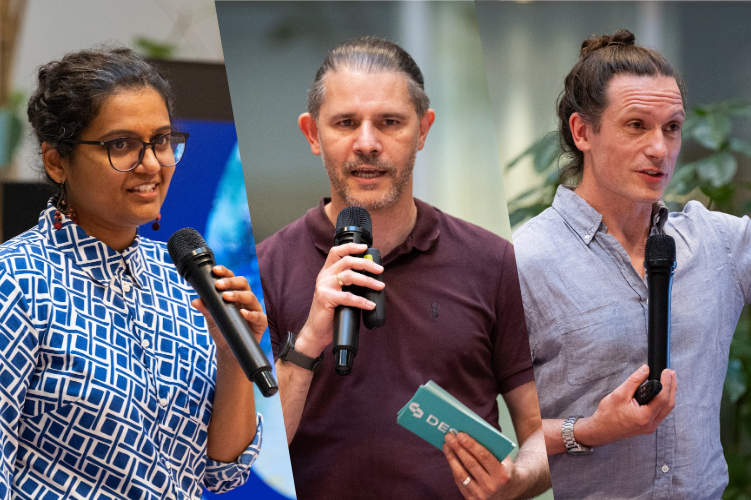
This 37th edition of Climate Tech Time landed right in the middle of London Climate Action Week with three speakers from three different corners of the ecosystem, and one thread running beneath all of them.
Aparna Shrivastava, Executive Director of The Climate Reserve, opened with a sobering account what’s been happening in US climate science over the past year, and what she’s doing at The Climate Reserve to preserve capability. Leonidas Howden, Managing Director of DESCycle, followed with a reminder that the largest metal deposit on the planet is probably sitting in your kitchen drawer. And Yannick Wurm, Co-Founder and CEO at the Advanced Research + Invention Agency (ARIA) closed with a vision for giving nature the equivalent of emergency care.
As different as each mission is, all three are in the business of rescuing expertise, metal, and species before it’s too late. Read on for the full roundup.
Strengthening the human infrastructure of climate science
Aparna Shrivastava, Executive Director of Climate Reserve, opened with the headlines that many of us have been following for over a year.
In 2025 alone, 96,000 scientists were made redundant or left the US federal government across climate, science, and health, and more than $15 billion worth of tax credits, direct programme funding, and research funding was cut.
For Aparna, this didn’t create new problems as much as reveal systematic ones, showing capacity gaps that were always there, knowledge that was never translating into action fast enough, and a fragmented ecosystem where the people working on the same crisis weren’t talking to each other.
It was watching this unfold from inside the government, as a senior climate official in the Biden administration, that pushed Aparna to move into the role of Executive Director at The Climate Reserve. The organisation exists to strengthen the human infrastructure behind climate work, on the basis that you can save a dataset or a model, but without the people who know how to run it, that only gets you so far.
The Climate Reserve is a small but mighty team of experts, from former government officials to academics and civil society, who identify where the highest-risk, highest-opportunity gaps are. So far, they’ve sent the first tranches of support to 27 people across the ecosystem last year and preserved dozens of critical climate functions.
Connect with Aparna on LinkedIn to follow her work, or visit the Aspen Global Change Institute to learn more.
“When billions are getting cut, the dollars that remain have to work 10 times as hard to ensure that progress is not lost.”
– Aparna Shrivastava, Executive Director of The Climate Reserve
The biggest metal deposit is above ground
Leonidas Howden, Managing Director of DESCycle, started his career doing exactly what most picture when they think about securing metals for the energy transition: financing mines. Along the way, he noticed something that didn’t add up. While the industry searched for the next tonne of copper, it was throwing away millions of tonnes of metal-rich electronic waste every year.
His conclusion: the world doesn’t have a shortage of metals. It has a shortage of infrastructure to recover metals.
About a decade ago, Leonidas met a group of researchers at the University of Leicester working on deep eutectic solvents, a chemistry where two solid compounds combine to form a liquid. The university had discovered this liquid was remarkably effective at recovering metals from electronic waste. Almost ten years on, DESCycle is now commissiong its first demonstration plant in Teesside, proving that process at scale.
For Leonidas, the biggest lesson of that decade is that the world doesn’t have an ideas problem; it has an execution problem. Universities and scientists produce brilliant ideas all the time; the real challenge is scale-up. Using the technology readiness level framework, he points out that the exciting, headline-grabbing part, where the science and the prototype work, is only around 10% of the journey. The other 90%, the unglamorous grind of development and deployment, is what actually changes the world.
He’s also come to see the “valley of death” as less a funding gap and more of a trust gap with investors, based on their belief in the founder or organisation that a company can advance. The hardest part of building DESCycle, Leonidas says, hasn’t been the cmeistry or fundraising but the consistent underestimating how long the journey takes and how to carry the uncertainty alongside founders.
Connect with Leonidas on LinkedIn to follow his journey, or learn more about how DESCycle is recovering metals from electronic waste.
“The world is not short of ideas. The world is short of ideas that survive contact with reality.”
– Leonidas Howden, Managing Director of DESCycle
Supporting nature to adapt before it’s too late
Yannick Wurm closed the evening with a look inside ARIA, the Advanced Research + Invention Agency, which was set up by an act of Parliament and has just turned three. ARIA’s model, new to the UK and Europe, is inspired by the funding approach the US developed during the Cold War space race: back entrepreneurially minded scientists, known internally as programme directors, with a vision for the future and the capital to move on it quickly.
Programme directors take all the executive decisions across their portfolios of £50-80 million, ARIA takes no equity, and despite being funded by taxpayers, the organisation tries to operate with the speed and agility of a startup. Over £200 million has already been committed across three programmes in the nature and climate space.
Two of those are run by Yannick’s colleagues. Sarah and Gemma’s Forecasting Tipping Points programme places sensors into the ice, snow, air, and water around the Greenland ice sheet to build a high-resolution, real-time picture of what’s happening, aiming to detect a climate tipping point early enough to act. Mark’s Explore Climate Cooling programme is examining the governance, feasibility and scalability of interventions like thickening ice sheets or seeding clouds.
Yannick continuously returns to the challenge of humanity’s relationship with nature. Species extinction rates are climbing before accounting for the full impact of climate collapse, driven in large part by 70% of land being used for industrial agriculture and invasive species. Yannick’s programme, Accelerated Adaptation, is investing £60 million into tools to intervene when an ecosystem is on the brink of collapse.
Connect with Yannick on LinkedIn to follow his work, or visit ARIA to learn more about their programmes in the nature and climate space.
“I’m 100% convinced that we can get on the pathway whereby both nature and humanity can flourish.”
– Yannick Wurm, Programme Director at ARIA
What connected Aparna, Leonidas and Yannick wasn’t the subject matter exactly, but more the unglamorous yet vital work of rescuing ecosystems and resources before it’s too late.
As this room at London Climate Action Week made abundantly clear, we do not build resilience in the easy times when things are going well. We build it when we are willing to do the slow, unglamorous, often invisible work to make sure nothing gets lost.
Our next Climate Tech Time is on Wednesday, 29 July. Sign up for our newsletter for updates on all London climate events happening in the month, and follow us here for more updates.