What’s your story, Buffy Price?
The stories behind climate tech founders
This year, we’re launching a new series of posts profiling founders of Climate Connection’s tech community, asking them to share their journeys, inspirations, and insights into how they got to where they are today.
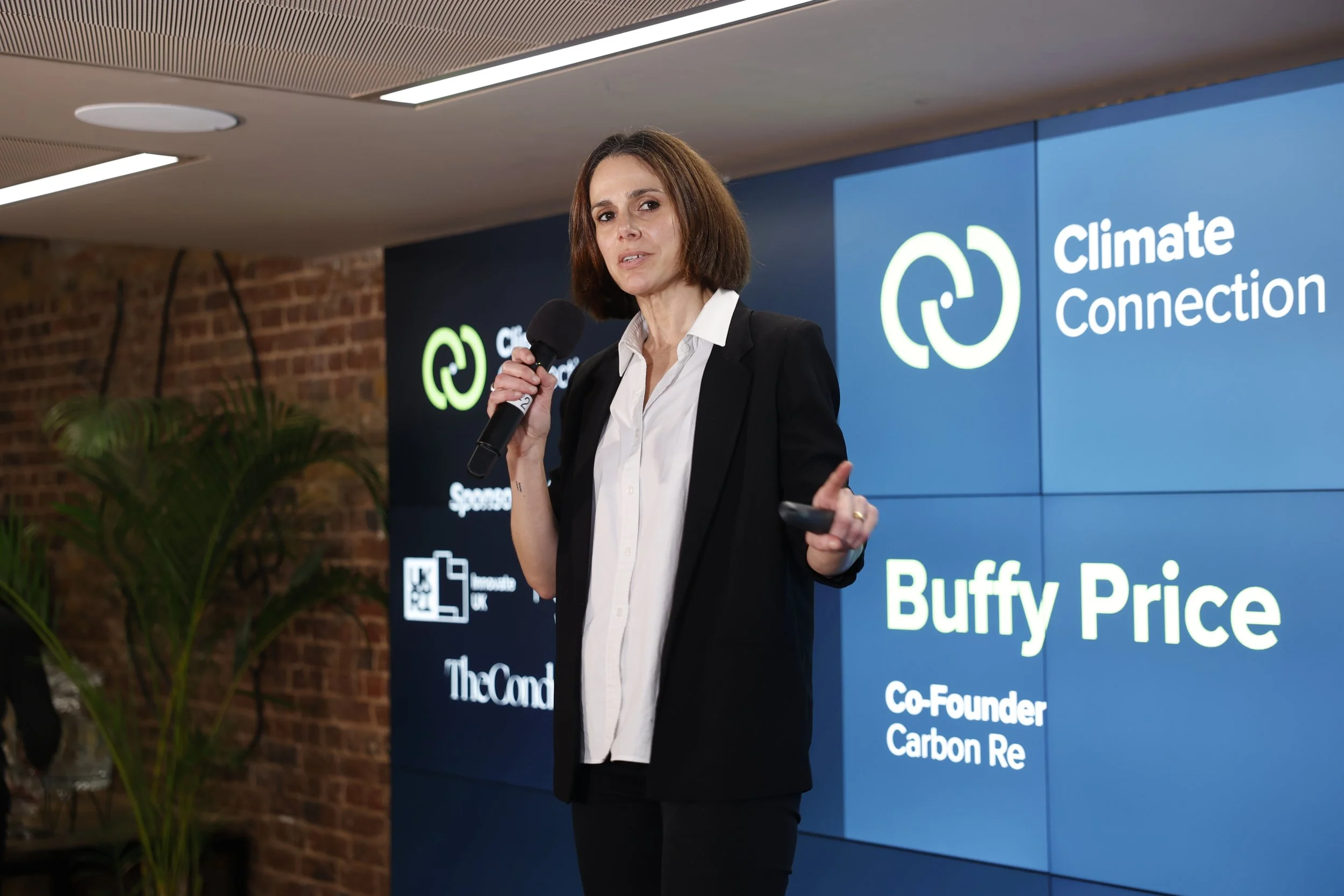
Today, we’re sharing the story of Buffy Price, the co-founder of Gigaton (previously known as CarbonRe). You may recognise her from our April Climate Tech Time, where she shared how her background at Amnesty International – using computer vision and language extraction to monitor human rights abuses – inspired her to co-found a company out of Cambridge to reduce carbon emissions from cement.
Here’s her story.
How did your career begin?
Not in tech or climate!
I have had what I like to call a portfolio career, which has pivoted around my skills in project management and my interest in sociopolitical impact. I've worked in politics, animal welfare, international development, film and human rights.
When I was at Amnesty International, I worked with their tech team that used technology as a tool for justice and accountability. Prior to founding Gigaton, I was working in the AI for Good programme at a large AI startup and exploring the possibilities of direct impact on climate change using AI.
How did you find the right co-founders and build the company around your different backgrounds?
I co-founded Gigaton with Sherif Elsayed-Ali, with whom I'd worked in two previous roles, Dr Daniel Summerbell, who came from the Institute for Manufacturing at Cambridge, and Professor Aidan O'Sullivan from UCL. The four of us had complementary skill sets and a shared motivation to build something with a tangible impact.
That matters a lot when you're working hard to get a company off the ground.
What have been the toughest challenges along the way?
Being taken seriously by an industry when you show up wearing trainers and a t-shirt and telling them that you are a trendy AI start-up that understands their problems.
We were walking into plants that have been running the same process for decades, talking to engineers who have forgotten more about kilns than most people will ever know and asking them to let our system learn from their processes and improve them. That required a level of trust that takes time to earn.
The other challenge is the one every climate tech founder faces: the gap between the problem's urgency and the pace of industrial adoption. Those two things are not moving at the same speed.
Have you ever felt like giving up?
Yes. I think anyone who says they haven't is either not being honest or hasn't been doing it long enough! Being a founder is exhausting and takes over your life. There are moments, usually when everything difficult is happening at once (including in your personal life), when you genuinely question whether you're the right person, whether the timing is right, and whether the sacrifices you're asking your family to make to help this happen are worth it.
I also firmly believe that the people who have the drive to start a company aren't necessarily the right ones to lead at every stage of a company's growth. After we reached our Series A, I was very happy to hand over the reins of the COO role to someone better suited to driving the next stage of organisational development, allowing me to focus on what I do best: advocacy, corporate affairs, government relations, and impact.
What has kept you going?
The scale of what's at stake for the planet, and the fact that what we are doing is working. Cement is responsible for around 8% of global CO2 emissions, and it's one of the hardest industries to decarbonise. When we see our learning control systems reduce fuel costs and cut carbon at a plant in real time, that’s meaningful - and it represents gigatonnes of potential impact. I also love working with the team at Gigaton; even on the hard days, they make it worth it to keep going.
What advice would you give to anyone else looking to build a climate tech startup today?
Start with the problem, not the product, and spend time in the space or industry you're trying to change. Also, be honest with yourself (and your investors) about timelines - industrial, digital and policy transformation are all slow processes, so you need to be in it for the long game and have the strength to dig deep and keep going. It's totally worth it because the opportunity is enormous and the climate tech community is amazing.
Can you tell us a story about how this community or an unexpected connection helped propel you to where you are now?
My line manager at Amnesty International, Richard, gave me the opportunity to work with Sherif on the Amnesty Tech team on secondment so I could learn about the direct impact that AI/ technology could have on social and climate change. The company we've built and the person I am today all flow from that generous boss who was willing to give me a growth opportunity.
So there’s a glimpse into one of the founders of our Climate Connection community – a community built around the strategic magic of connection and intentional networking.
Interested in seeing yourself or another founder onstage?
We’re always looking for new startups and scale-ups to tell amazing stories. You can fill out our speaker nomination form here.