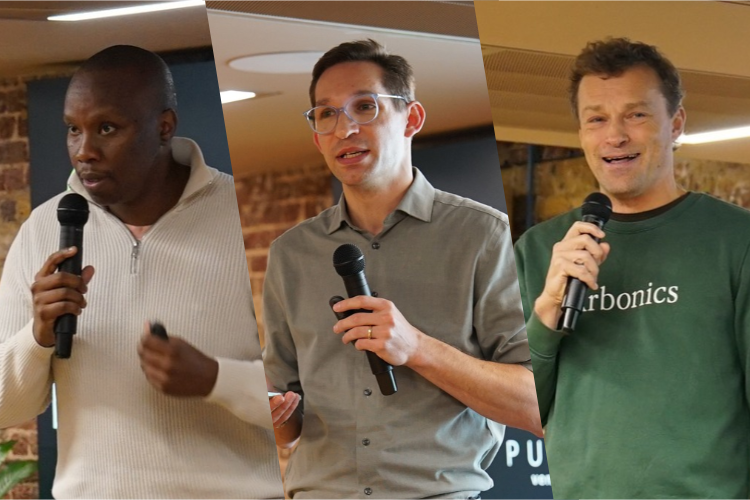
In October, we hosted our 40th Climate Tech Time at The Conduit, bringing together founders, investors, corporates and more. With the clocks days away from going back, the Climate Connection community came together once again to hear three speakers talk about value hiding in plain sight.
Mo Mophethe, Founder and CEO of Metal Morph, traced a line from collecting water in a village in Lesotho to recovering the treatment chemicals that UK water utilities send to landfill.
Next came a surprise speaker. Alistair Holzhauer-Barrie, Partner at GJE, showed how intellectual property owned by someone else can rename a company, knock value off a listing, or hand a small business leverage over a giant.
Then Kristjan Lepik, Co-Founder and CEO of Arbonics, skipped the pitch altogether and closed the night with a bet: that land is mispriced, and that forestry carbon projects will beat AI returns over the next 4 years.
Read on for the full roundup.
Turning wastewater into supply chains
Mo Mophethe, Founder and CEO of Metal Morph, opened with two questions for the room. Every expedition needs a true north star, so what's yours? And what exactly is scarcity?
His answer started in a village in Lesotho. Before school, Mo and his friends would walk to the boreholes to collect drinking water. As the wells ran dry, they walked further and further, until many of the boys couldn't make it back in time for school. The same water fed the family farms. When families had to choose between drinking and irrigation, they chose drinking, and some married off their daughters for money.
Scholarships took Mo through high school and university, where he studied chemical engineering and specialised in separation technology: pulling valuable components out of mixtures. His first company worked in water and wastewater across mining, pharmaceuticals and utilities, and it kept bringing him back to one question. What's actually in the waste?
The answer was aluminium and iron. Their derivatives treat drinking water and sewage, and they show up across oil and gas, FMCG (think Coca-Cola, beer, and wine), and mining. We mine them, refine them, use them once, then pay again to send the spent sludge to landfill. Every purchase carries three problems:
Price swings of around 450%, passed down from the mine to the end client
Carbon, since aluminium and iron ore are among the most carbon-intensive processes after fertiliser and concrete
Fragile supply chains, with bauxite in Guinea, Brazil and Australia while the manufacturing capability sits in China
UK drinking water treatment plants alone send 100,000 tonnes of sludge to landfill. Meanwhile, aluminium, one of the world's most abundant metals, is classed as a critical mineral by the UK and the EU.
Metal Morph's 3-step electrochemical process (leaching, Donnan dialysis, and nanofiltration) recovers, reactivates, and recycles these metal-based chemicals for use in drinking water treatment and nearby industries. The company is still pre-seed, yet it already has partnerships with eight of the UK's 11 water utilities. It consistently recovers 90% of the metals and chemicals at 95% purity, with lower carbon emissions.
Years later, Mo learned that Lesotho is one of Southern Africa's most water-rich countries. The water was always there; the ability to reach it wasn't. So Metal Morph's true north star is to make what we already have enough.
Connect with Mo on LinkedIn to follow his journey, or visit Metal Morph to learn more about how they're turning wastewater into supply chains.
"Often, scarcity is a design choice, not a reality. And what we design, we can also redesign."
– Mo Mophethe, Founder and CEO of Metal Morph
The IP lessons hiding behind household names
Our surprise speaker of the night, Alistair Holzhauer-Barrie, Partner at GJE and one of our community partners, started with a show of hands. Who recognises Monzo? Fewer people knew it started life as Mondo, and was forced to rebrand the whole company early on, against its wishes.
Then he turned to Android.
Google develops the world's most popular phone operating system, but historically it hasn't made money from the software running on it. Microsoft has. As recently as a few years ago, Microsoft was earning around a billion dollars a year this way, collecting $10 to $15 on every handset.
Both stories come down to IP. Specifically, how IP owned by someone else on a company can impact a business’s own product, even if they developed and built it from scratch. If the largest tech companies can get caught out, smaller companies in emerging sectors like climate tech are far more exposed.
Closer to home, Alistair shared two cases from his own clients:
A company preparing to list on AIM found that, in a crucial market, it didn't own the rights to the logo of its most popular product range; they'd obtained the logo through underhand behaviour. Disclosing it knocked significant value off the listing. The upside is that the company now takes IP seriously, and legitimately saves hundreds of thousands of pounds a year through UK tax benefits on the patents GJE helped it secure.
Over the summer, a much larger company made as much from a single month of Kickstarter as one of his clients makes in a year. Because that client was watching the space and had spent ten years securing its IP, the larger company is now in licensing talks with them.
His advice was to work out what you care about: the company name your reputation is built on, the brand and product names you don't want stolen, and the technology you're developing. Then work with an IP partner as early as you can, before you're facing competitors and investors.
Connect with Alistair on LinkedIn, or visit GJE to learn more about protecting what you're building.
"If even some of the largest tech companies in the world can fall foul of this, you can imagine how often it happens to much smaller companies."
– Alistair Holzhauer-Barrie, Partner at GJE
Why the land under Europe's forests is mispriced
Kristjan Lepik, Co-Founder and CEO of Arbonics, took the stage and promised not to pitch. Instead, he gave away an idea he picked up while building his company, in case someone in the room wanted to turn it into a new venture.
First, for context, Arbonics runs forestry carbon projects.
Landowners commit to doing good for the planet, get paid only once the impact is proven, and large corporations finance it. Its free software for landowners shows how and where they can earn from carbon, and Arbonics takes a share of revenue from those who sign up. In two years, its digital reports have reached landowners across almost all of Estonia and Latvia, with interest covering more than a million hectares. Arbonics has signed 10,000 hectares and planted more than ten million trees. As Kristjan put it, it's proof that technology can make this understandable to everyone, from75-year-old farmers to new generations inheriting or buying land.
Their thesis is that if you own a forest, the only way to make money from it is to cut it down. Clear-cutting makes Kristjan angry, until he remembers the landowner might need to pay medical bills or fix a roof. Planting costs around £2,000 a hectare, and the payoff arrives when you fell the trees fifty years later. Spread over those fifty years, that's roughly 5% a year, barely more than a bank deposit;most landowners jokingly tell him it's nice, but they'll be dead by then.
Add carbon and the return climbs to nearly 9%, with some revenue arriving much sooner. That's starting to change land as an asset class, and Kristjan believes land is mispriced almost everywhere, with "a lot of spreadsheets" behind him. Carbon markets are still young, but capital is moving. At Climate Week in New York, he saw US investors looking to buy land in Europe, and J.P. Morgan already has a natural assets fund of more than a billion. Yet most of the thousands of landowners Arbonics talks to still don't see it.
So he made two bets:
Forestry carbon projects will beat AI returns over the next four years
By 2035, carbon and biodiversity will overtake timber as the main source of value in a forest
Connect with Kristjan on LinkedIn, or visit Arbonics to learn more. And if you're thinking about starting a land fund, or want to hear about Arbonics' UK project, he'd like to talk to you.
"I'm so convinced that if somebody wants to make a bet with me, I'm willing to do it. If you do this forestry carbon project, you will beat AI returns over the next four years."
– Kristjan Lepik, Co-Founder and CEO of Arbonics
Register for the next Climate Tech Time on 25 November at The Conduit.
Sign up for our newsletter for updates on all London climate events happening in the month, and follow us here for more updates.